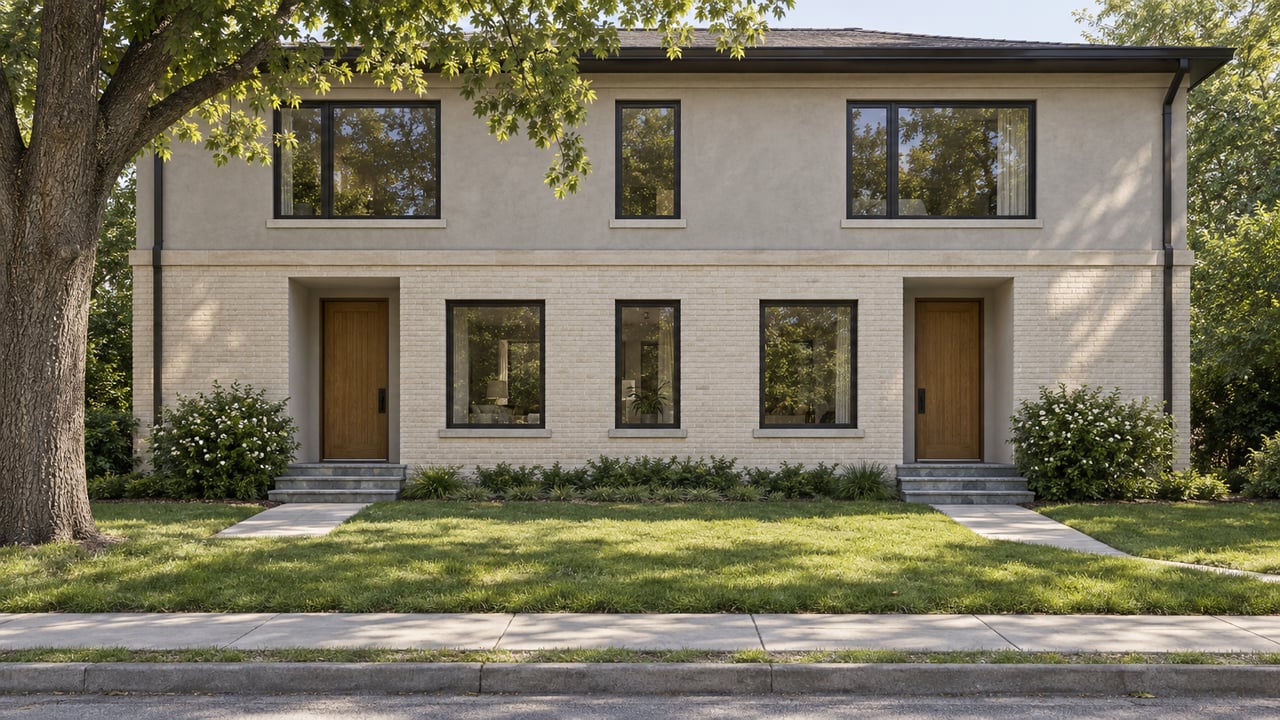
In March 2026, a five-bedroom, three-and-a-half-bath half of a brand-new duplex in Arlington's North Highlands neighborhood closed for $1,610,000. The lot beneath it had been rezoned under the county's Expanded Housing Options ordinance, the policy most people around here just call Missing Middle. County planners spent years pitching that framework as a fix for Arlington's shortage of housing that middle-income buyers could actually afford. The unit sold like any other new-construction listing inside the Beltway: fast, and for well over a million dollars.
That sale, reported by ARLnow in April, is the clearest evidence so far of what Arlington's Missing Middle policy has actually produced after three years of construction, lawsuits, and appeals. It doesn't mean the policy failed. It means a zoning change and an affordability outcome are two separate things, and in Arlington's land market they haven't lined up yet.
If you're comparing Arlington to other Northern Virginia neighborhoods and you've read headlines saying the county "legalized duplexes and sixplexes everywhere," here's what those headlines tend to leave out.
What the Ordinance Actually Allows
The Arlington County Board adopted the Expanded Housing Options ordinance in March 2023, and it took effect that July. Before the change, about three-quarters of the county's residential land was zoned to allow exactly one dwelling per lot. EHO added a by-right path to build duplexes, three attached townhouses, or multiplex buildings of up to six units on those same lots, without a special exception or a rezoning case.
The ordinance didn't remove size limits along with the unit-count limits. A duplex is capped at 4,800 square feet of gross floor area. New units must face the street rather than a shared driveway or interior courtyard. Parking minimums still apply, though they scale down near Metro stations. In practice, a builder splitting one lot into two units can still build close to the same total square footage a single-family replacement would have used, just divided between two owners instead of one.
Why the Land Math Still Wins
Arlington's redevelopment pattern was already skewed toward larger, pricier homes before EHO existed. A county study using 2019 data found the average single-family teardown was 1,515 square feet with three bedrooms, and the house that replaced it averaged 4,750 square feet, more than triple the size, selling for around $1.7 million. Land, not the structure sitting on it, has been the scarce input in this county for a long time. Land alone commonly runs 15 to 40 percent of the total cost of a teardown-and-rebuild project here, and up to 60 percent on the rare vacant infill lot.
That's the constraint EHO walked into. A 4,800-square-foot duplex split into two roughly 2,400-square-foot halves, built on land priced for a location where the median sale price per square foot reached $509 over the three months ending July 2026, up 8.4 percent from a year earlier, doesn't produce an affordable unit. It produces two units that price like new-construction single-family homes, because that's what the size, finishes, and location already command on that land regardless of how many owners split the deed.
Builders already know this. Classic Cottages, one of the custom homebuilders active in Arlington's teardown market, introduced a "Midtown Collection" line of smaller, 3,000-to-4,000-square-foot houses on smaller lots specifically to hit a lower price point than its standard product. Those smaller homes have priced between $1.75 million and $1.95 million. The first EHO duplex sales are landing in a similar band, just split across two units on one lot instead of one house on one lot.
| Path | What it costs to build | Legal footing today | What actually gets built |
|---|---|---|---|
| Traditional teardown, single-family | Land $500K-$1.25M, demolition and prep $75K-$100K, build $200-$450 per sq ft | Fully settled, no litigation | One home, averaging 4,750 sq ft per the county's 2019 study |
| EHO duplex or multiplex | Hard construction cost $259-$346 per sq ft, plus land, split across units | Currently valid law, under Virginia Supreme Court review | Two to six units, first recorded sale at $1.61M for one half |
| ADU added to an existing home | $302-$454 per sq ft, roughly $242K-$363K for an 800 sq ft detached unit | Governed by a separate 2019 county ordinance, not part of the lawsuit | One added unit, rents $2,100-$3,000 a month, reported to add $100K-$175K in resale value |
Three Years, Two Courts, No Final Answer
Anyone pricing a lot's EHO potential is also pricing in a lawsuit that hasn't finished. The timeline so far:
- March 2023: The County Board votes unanimously to adopt the EHO ordinance.
- September 2024: In Nordgren v. Arlington County Board, Circuit Court Judge David Schell rules for the plaintiffs, nine Arlington homeowners, finding the county failed to follow proper procedure and didn't adequately study impacts like stormwater and tree canopy. The ruling voids the ordinance from the beginning and freezes 45 already-approved permits.
- June 24, 2025: The Virginia Court of Appeals reverses, on procedural grounds. It finds that developers who already held EHO permits, including Wilsons Ventures, should have been named as parties to the suit and weren't. The ordinance goes back on the books, but the reversal never addresses whether the county passed it lawfully in the first place.
- April 8, 2026: The Virginia Supreme Court hears oral arguments on whether to take up the case.
- May 19, 2026: The Virginia Supreme Court agrees to review it. A spokesperson for Neighbors for Neighborhoods, the group funding the homeowners' litigation, said at the time that a trial could happen within three to six months, which would place it sometime in the back half of 2026.
While all of that plays out, the county keeps processing applications. After the Court of Appeals ruling, Arlington approved nine more EHO projects totaling 40 units by April 2026, bringing the total on the county's public permitting dashboard to 59. Some of those have quietly pivoted back to single-family construction rather than ride out more legal uncertainty. If the Supreme Court eventually sides with the homeowners, the case doesn't just end. It goes back to trial court for a new hearing, this time with every EHO permit holder entitled to join as a party, which is a very different and much larger case than the one that started this fight.
The Quieter Bet: Accessory Dwelling Units
There's a second way to add a unit in Arlington that hasn't spent three years in court. Accessory dwelling unit rules here trace to standards the county set in 2019, entirely separate from the EHO ordinance and untouched by the Nordgren litigation. A detached ADU is capped at roughly 750 square feet of floor area, with a smaller footprint limit of 560 to 650 square feet depending on the zoning district, and setbacks as tight as five feet from the property line.
The numbers are more modest than a duplex, and more predictable. An 800-square-foot detached unit lands around $242,000 to $363,000 all in, based on regional per-square-foot cost data. It rents for roughly $2,100 to $3,000 a month, close to a 5 to 7 percent annual return. One contractor's analysis of county permit records, covering filings from January 2019 through March 2026, found that a well-built, permitted ADU adds $100,000 to $175,000 to a home's appraised value. ADU permits themselves grew from 47 annual filings in 2019 to 273 in 2025, a 480 percent increase, with Bluemont and Westover leading adoption thanks to larger lot sizes and Metro proximity, and Lyon Park commanding the highest average project values.
One structural difference is worth knowing before you plan around it. Arlington still requires that either the main house or the new unit be owner-occupied. That requirement is expected to hold even after Virginia's new statewide ADU law takes effect in July 2027, since Arlington's existing ordinance already qualifies for an exemption written into that law. An ADU here is a way to add income or space to a home you live in. It isn't structured as a stand-alone investment lot the way an EHO unit is.
What This Means If You're Comparing Lots
An EHO-eligible lot in Arlington isn't a shortcut to a lower price point. It's a bet that a builder can extract two to six independent sale prices from one parcel, at levels the local per-square-foot market already supports. That bet currently comes bundled with a Virginia Supreme Court case that could send the entire ordinance back to a trial court, this time with dozens of permit holders as named parties. Anyone evaluating a lot's redevelopment potential, whether they're buying it or selling it, is pricing in that legal uncertainty whether or not it gets said out loud.
For a homeowner weighing what to build for themselves rather than to sell off in pieces, the ADU path is the version of "more housing on this lot" that isn't waiting on a court date.
A Few Questions Worth Asking Directly
Is Missing Middle zoning still legal in Arlington right now? Yes. The ordinance remains in effect while the Virginia Supreme Court reviews it, and the county continues to accept and process applications under it.
What happens if the Virginia Supreme Court sides with the homeowners who sued? The case returns to the trial court for a new hearing, this time with EHO permit holders named as parties alongside the county and the original plaintiffs.
Does any of this affect Arlington's ADU rules? No. ADUs are governed by a separate ordinance the county set in 2019, and that framework has not been part of the Nordgren litigation.
If you're weighing what a specific Arlington lot actually qualifies for under current law, and what that math looks like if the ruling changes, that's worth a real conversation before you write an offer or set a listing price. Property Collective can walk through it with you. Schedule a call.